
Need for AI governance? ki-beratung.st supports you
AI is at work in most companies, often without clear rules. ki-beratung.st turns the EU AI Act into clear roles, lean processes and auditable documentation.
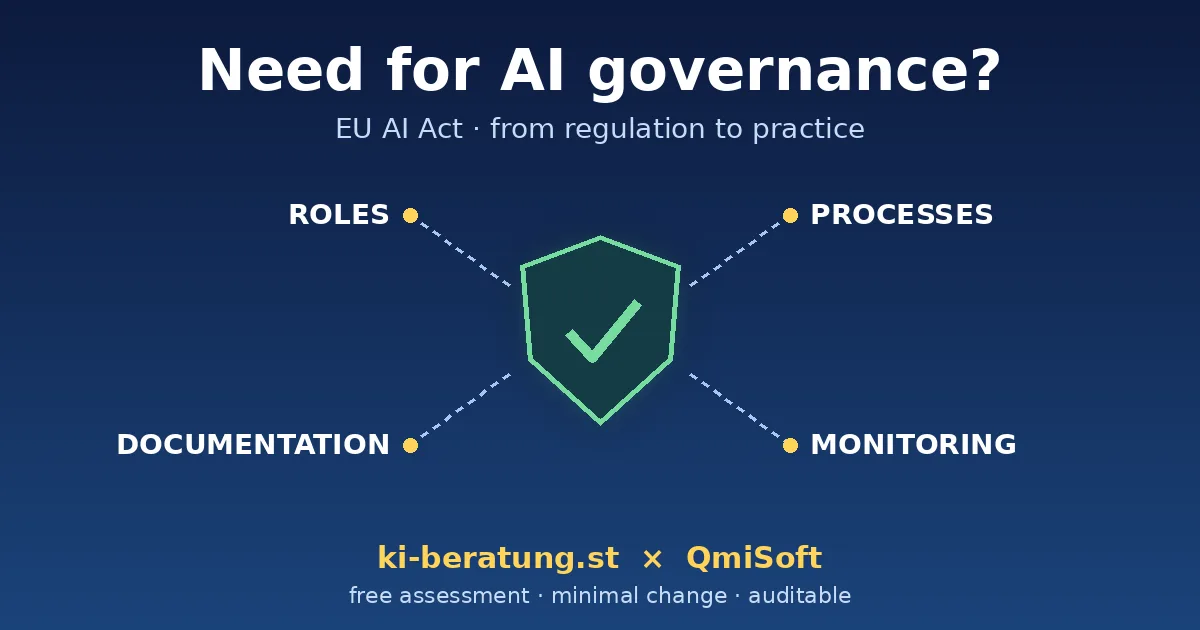
AI is already part of everyday work in most companies: a chatbot here, text generation there, an automated evaluation in the background. Often nobody can say exactly which AI systems are in use, who is responsible for them and which rules apply. That is exactly where AI governance starts — and where our sister brand ki-beratung.st supports you.
Why AI governance matters now
The EU AI Act is in force and its obligations apply step by step:
- Since February 2025, certain AI practices are prohibited, and companies must support sufficient AI literacy among the people who work with AI.
- Since August 2025, rules for general-purpose AI models apply.
- Transparency obligations — for example making clear when people interact with AI or see AI-generated content — follow from August 2026.
- The obligations for high-risk AI systems were postponed by the EU’s “AI Omnibus” in July 2026: to 2 December 2027 for stand-alone systems (Annex III) and 2 August 2028 for AI in regulated products (Annex I).
The postponement is not a reason to wait — it is time to prepare properly. Customers, auditors and management already ask how AI is being used, and a clean inventory and clear responsibilities cannot be built overnight.
From regulation to everyday practice
ki-beratung.st translates regulatory requirements into clear responsibilities, structured processes and traceable documentation — practical, economical and with minimal intervention in the way you already work. The services build on each other:
- Free assessment — where does your company stand today on AI governance, policies, standards and regulatory requirements?
- Competence & awareness — management and staff understand the opportunities, risks and responsibilities of using AI.
- Inventory & governance integration — all AI applications, systems and processes are recorded and transferred into a sustainable governance structure.
- Process analysis by the minimal-change principle — requirements are met with the least possible organisational change.
- EU AI Act & compliance in practice — the requirements are mapped onto your concrete organisation and system architecture: understandable and auditable.
- Process support & optimisation — AI governance is integrated into existing quality, risk and management processes.
- Evidence, monitoring & continuous improvement — auditable documentation with key figures and an improvement cycle that satisfies management, customers, auditors and the AI Act.
Governance meets engineering
ki-beratung.st and QmiSoft work hand in hand. ki-beratung.st defines what has to be governed and documented; QmiSoft builds how it runs technically — for example secure on-premise AI solutions, controlled workflows and automation that keep sensitive data in-house. Rules and technology fit together from the start instead of being patched together afterwards.
ki-beratung.st practises what it recommends: its own website chatbot stays switched off until it has passed the internal AI-governance approval.
Your next step
Do you know which AI tools your teams use today — and who is responsible for them? If not, the free assessment is the ideal starting point. Visit ki-beratung.st or write to info@ki-beratung.st. For technical implementation, talk to QmiSoft.
This article provides general information and is not legal advice.