
Loop engineering: turning defined processes into reliable, self-checking loops
Loop engineering designs repeatable work cycles with clear goals, automatic checks and human approval — freeing capacity and making processes faster and more reliable.
Most discussions about AI in software development still revolve around the single prompt: ask a question, get an answer, copy the result. From the perspective of software architecture and quality management, that is the least interesting part. What matters is the process around it — and that is exactly what a method called loop engineering addresses.
What loop engineering means
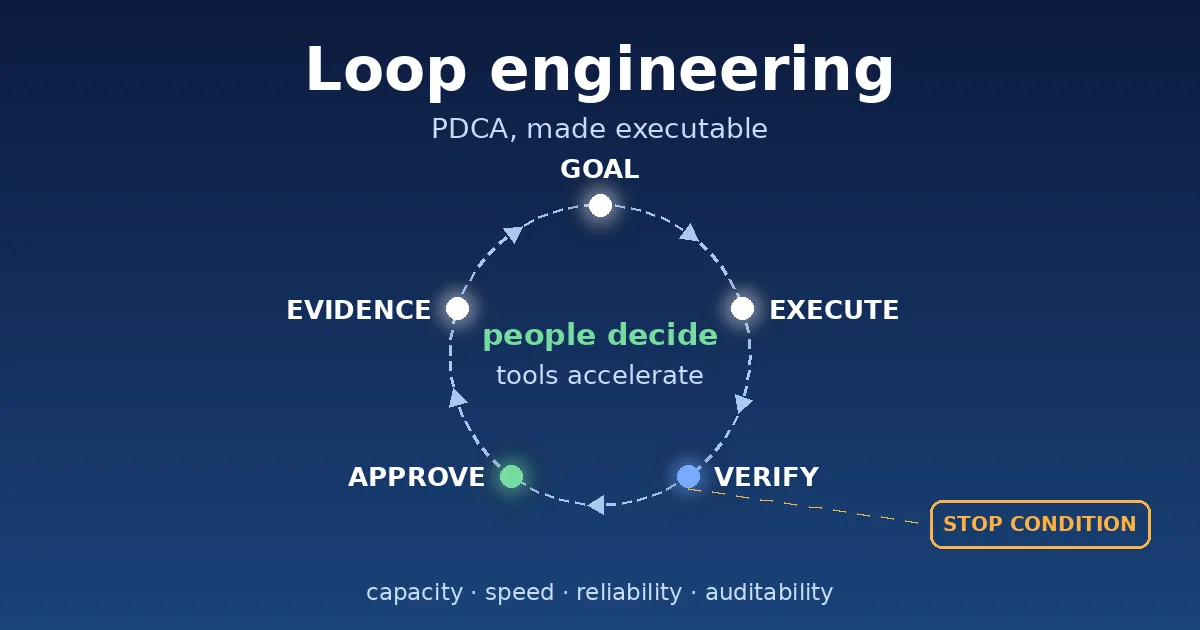
Loop engineering is the deliberate design of repeatable work cycles in which automated steps — increasingly AI agents — execute a task, check their own result against defined criteria, correct themselves and repeat until the goal is reached or a defined limit is hit. The term gained wide attention in the software community in 2026, but the underlying idea is familiar to anyone in quality management: it is the PDCA cycle (Plan – Do – Check – Act), made executable.
The difference to a one-off prompt is structural. A well-engineered loop does not depend on someone getting the wording right once; it defines what “done” means, how it is verified and when a human must decide.
The anatomy of a well-designed loop
From an architect’s point of view, every productive loop needs the same building blocks:
- Trigger — what starts the loop (a new requirement, a failed test, a scheduled review, an incoming document).
- Goal and acceptance criteria — measurable and written down before execution starts.
- Execution — the automated part: generating, transforming, testing, collecting data.
- Verification — independent checks: tests, rules, reviews, comparisons against references. A loop is only as good as its checks.
- Stop conditions and failure limits — maximum iterations, time and cost budgets, escalation when the loop does not converge.
- Approval gate — the point where a responsible person reviews and releases the result. People decide, tools accelerate.
- Evidence — every run leaves a traceable record: input, version, checks, result, approval.
Without verification and stop conditions, a loop is not engineering — it is a risk that runs unattended.
Why it pays off: capacity, speed, reliability
A carefully designed loop takes over exactly the work that ties up experienced people without using their experience: repeated checks, routine corrections, reformatting, collecting evidence. The result:
- Freed capacity — specialists spend their time on decisions, architecture and customer contact instead of repetitive rework.
- Faster implementation — iterations that used to wait for the next free hour run immediately and around the clock.
- Higher reliability — the same checks run the same way every time; nothing is forgotten because someone was in a hurry.
- Built-in auditability — the evidence a quality system or auditor asks for is produced as a by-product, not compiled afterwards.
From the management manual to an executable loop
This is where loop engineering becomes particularly valuable for companies with a quality management system. The processes defined in your management manual — document control, change management, supplier evaluation, complaint handling, internal reviews — are, at their core, already loops: input, activity, check, release, record.
In practice, however, they often live as text and flowcharts that are interpreted differently by different people. Loop engineering makes them explicit and executable:
- Each process step gets a clear input, output and acceptance criterion.
- Routine steps are automated; checks run against the defined criteria.
- Release and responsibility stay exactly where the manual assigns them — with people.
- Key figures (lead times, error rates, rework) are measured automatically and feed the next improvement cycle.
The welcome side effect: weaknesses in a process description become visible immediately. A step that cannot be expressed as a verifiable loop is usually a step that was never clearly defined.
Where loop engineering needs discipline
Loops are powerful — and that is why they need governance:
- Clear permissions: what a loop may read, change and publish is defined and limited.
- Data protection by design: only the data a step requires, processed where it is allowed to be processed.
- Cost and resource limits: every loop has a budget and stops when it is used up.
- Human escalation: unclear results go to a person, not into another iteration.
For AI-based loops in particular, these rules are also part of a sound AI governance — the topic our sister brand KI-Beratung.st supports companies with.
How we apply it at QmiSoft
We use loop engineering in our own development and in customer projects: tests, reviews, builds, documentation checks and release preparation run as controlled loops, with clear acceptance criteria and a person who releases the result. It is the same principle as our nine-step approach and part of how QmiSoft keeps getting more efficient.
Would you like to know which of your processes are suitable for a well-designed loop — and what it would free up? Talk to us.
Sources
- ADTmag – Loop engineering emerges as developers put AI coding agents on repeat (1 July 2026)
- Build Fast with AI – Loop engineering guide
- ISO 9001 – Quality management systems (current edition ISO 9001:2026)
Sources checked: 3 October 2026.