Go international: why we are learning Chinese
QmiSoft's go-international strategy starts with openness to languages. That is why we study Chinese — to get ready for one of the greatest markets in the world.
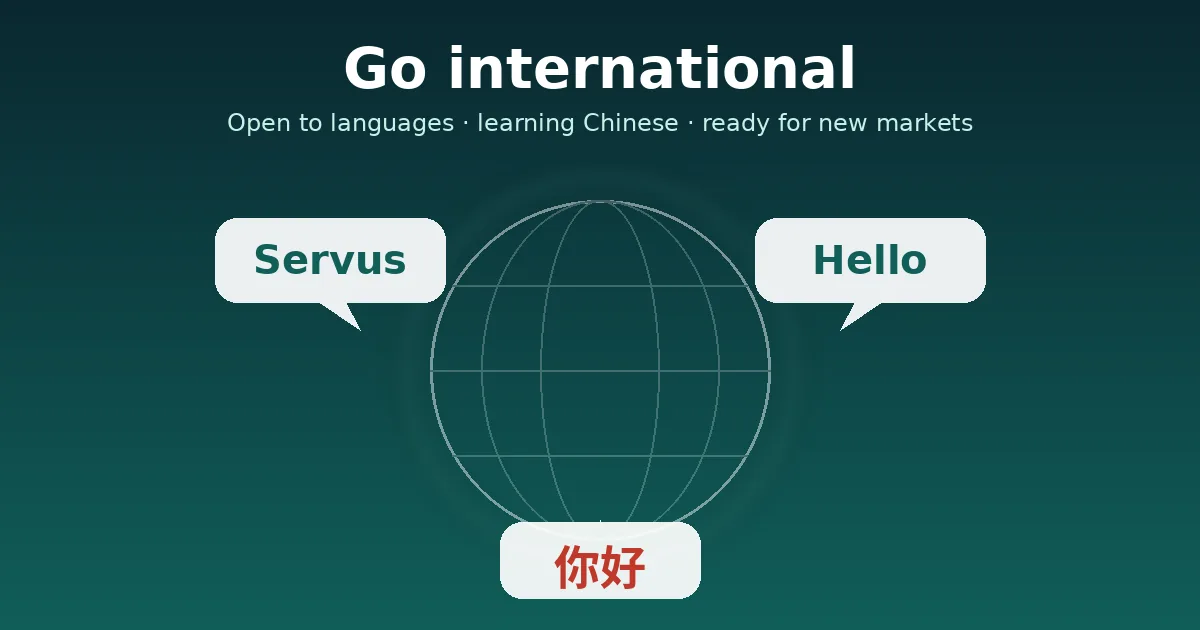
Servus in Styria, hello in the rest of the world, 你好 in China. Three greetings — and the essence of our go-international strategy: openness to languages.
QmiSoft is at home in Birkfeld, Austria. Our software, however, is used wherever our customers work. That is why this website speaks three languages — German, English and Chinese — and why we have taken the next step: we are studying Chinese.
Software starts with understanding
In our process, the second step is called Study — with experience. Before a single line of code is written, we need to understand how a business really works: its requirements, its constraints, its people.
Understanding is always also a question of language. Requirements get lost in translation, datasheets are misread, nuances disappear. Whoever speaks the customer’s language — even just a little — asks better questions and hears the answers more precisely.
Why Chinese?
China is one of the greatest markets in the world, and a large part of today’s hardware, electronics and industrial automation is designed or built there. For a company like ours, which connects software, IoT and automation, that matters every day:
- Datasheets and standards. Many components come with Chinese documentation, and China has its own national standards (GB standards). Reading them directly is faster and safer than guessing.
- Partners and suppliers. European companies working with Chinese partners need someone who can bridge not only the technology but also the communication.
- The other direction. Chinese companies entering Europe need partners who know European requirements such as the GDPR and the EU AI Act.
Hong Kong plays a special role here. Through our membership in AI Tinkerers, we are connected to a community whose Hong Kong chapter sees itself as a bridge between East and West — with meetups in English and demos welcome in Cantonese and Mandarin.
How we learn
We are learners, not native speakers — and we say so openly. We learn step by step:
- Everyday and business language for respectful, clear communication.
- Technical vocabulary for software, automation and project work.
- Reading technical documents such as datasheets and specifications.
- Culture and business etiquette, because good cooperation is more than grammar.
Our Chinese web pages are a start. They were created with machine assistance, and we keep improving them. If you are a native speaker and spot something to improve: please write to us — 欢迎指正!
What this means for our customers
For you, our go-international strategy means one thing above all: fewer misunderstandings on the way from your request to the solution — whether your project, your partners or your markets are in Europe or in Asia.
学无止境 — learning never ends. We are looking forward to it.